
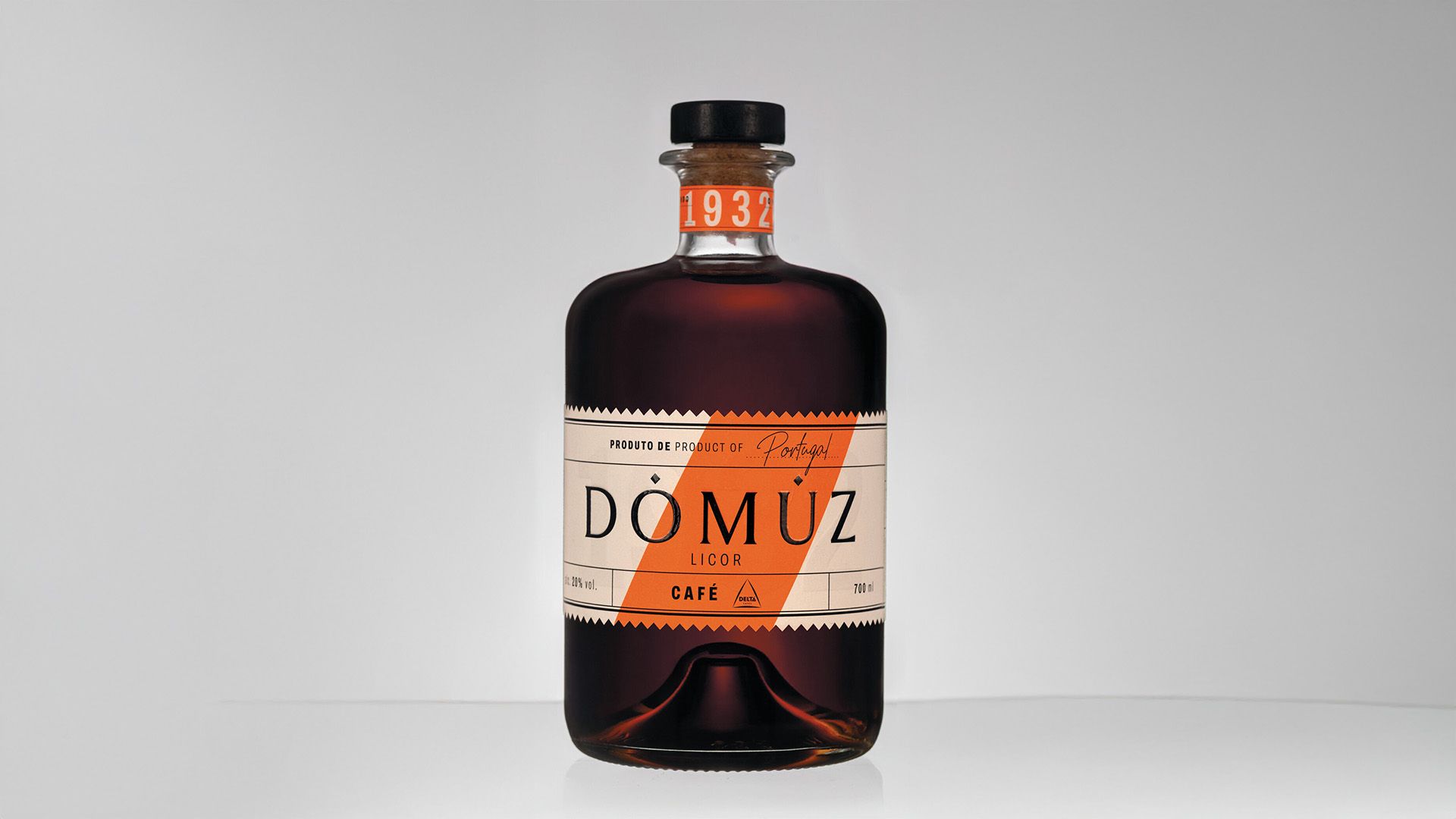
According to its general director, Pedro Foles, “it is almost a refounding of the brand.” The goal for the new coffee and bitter almond liqueurs, he says,
It is a positive evolution. The bottles used to be tall, now they are short, and the labels, and even the logo, are completely different,” sums up André Coelho, from Co&K, the agency that coordinated the rebranding of Dómúz, a national reference in the 60s and 70s thanks to its anise liqueurs – the traditional, transparent one, and “Mel de Damas”, sweeter and aimed at a female audience. Times have changed and, with them, the tastes and preferences of consumers.
“We had to reconsider everything,” says Pedro Foles, general manager of Adega Mayor, who now faces the challenge of managing Dómúz. “It is the group’s oldest brand, founded in 1932, even before Camelo cafés, and we did not want to give it up,” he adds. And he stresses: “A brand that lasts almost one hundred years certainly has value, and a story to tell, which needs to be brought into the present day. That was our starting point.”
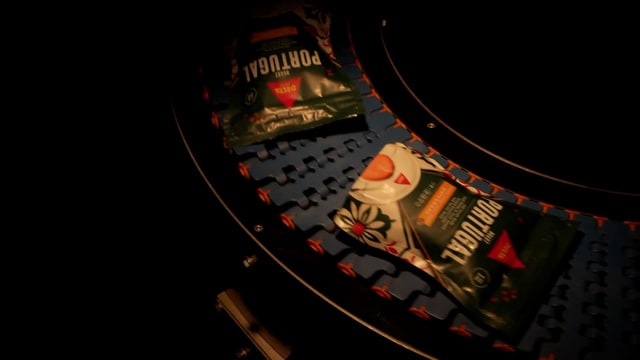
This blend has Delta quality, a leader in the coffee bean segment, and it arrives to make a difference in the coffee ritual of the Portuguese.
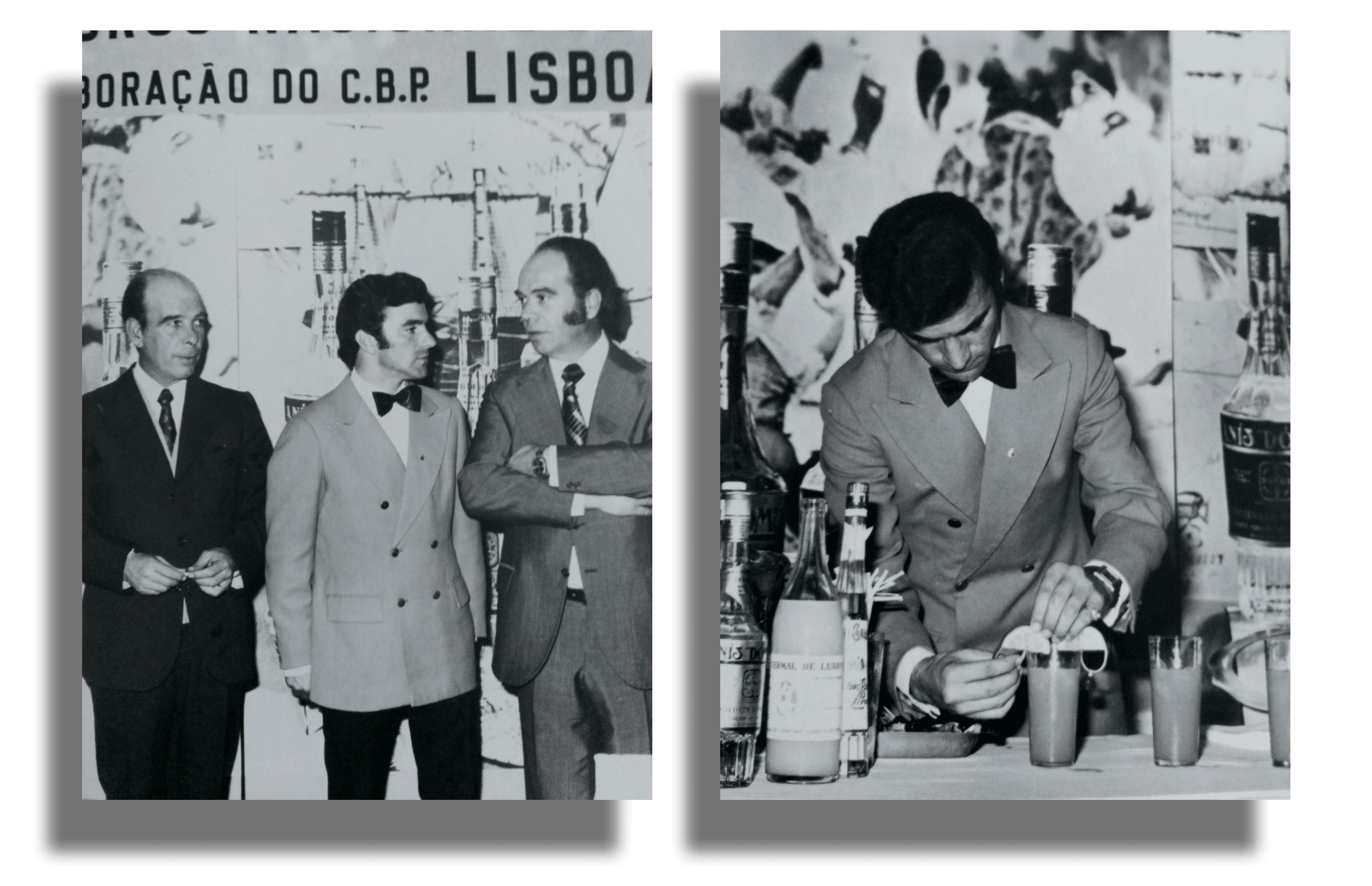
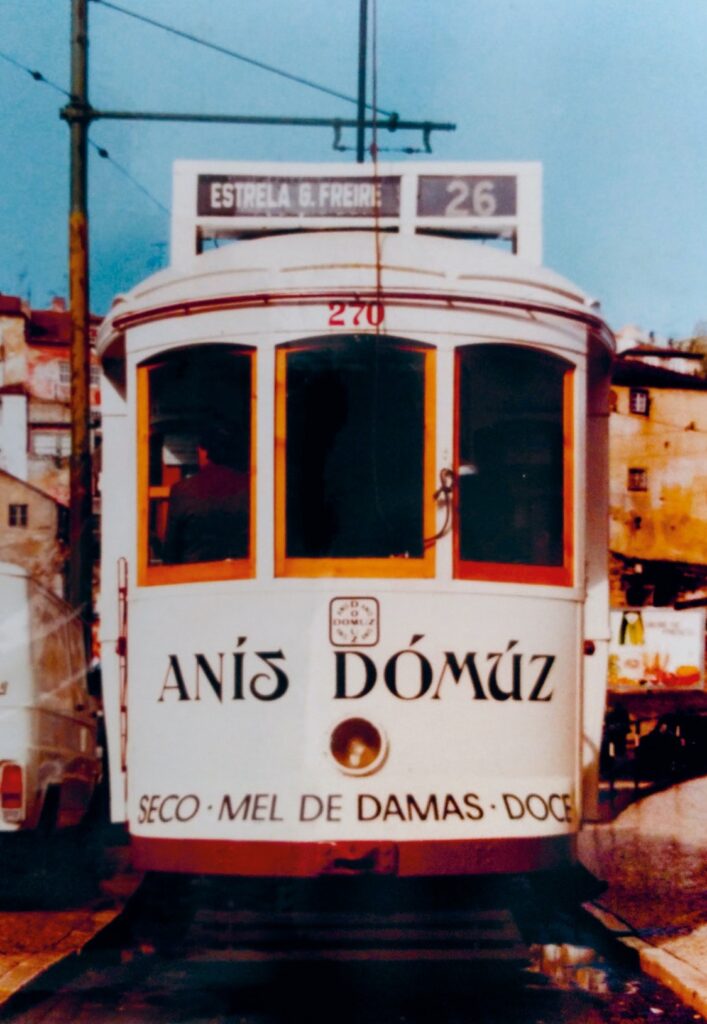
Of course, if there were still a spectrum of regular Dómúz consumers, such a disruptive rebranding might not be advisable, but that is not the case. “The consumer who lived through that moment of greater visibility, of greater expansion of the brand, today no longer has a relationship with it. It is a brand that means nothing to young people, and that older people, who remember it, have stopped consuming,” says Pedro Foles, recalling that “it was a range that was dormant within Grupo Nabeiro.” The anise liqueurs will be discontinued, as they do not have the potential to justify their maintenance. This is not the case for the coffee and bitter almond varieties. Now, in the first year, we aim at least to double the brand’s sales, but we believe that growth may be much more significant than that.
In fact, depending on how the market responds, Dómúz liqueurs with other aromas may even be created. But without rushing: “The brand is now being reborn with these two references, but the vision is that, further ahead, it will be expanded with other drinks that are relevant for our clients and consumers.” The Portuguese will not be the only ones to shape its future: “The brand has international distribution, with a particular presence in Spain, where it has taken root, associated with the habit of the chupito, which is the equivalent of our abaladiça, that drink offered after a meal or after coffee.”
In this sense, in the Portuguese market, liqueurs are also mostly taken as digestifs, competing with Port wine and Madeira, among others. But these in particular have a different consumption opportunity: “They are moments of enjoyment outside meals, when liqueurs can be consumed on their own or in cocktails.” Bitter almond is excellent for late afternoons, served simply with ice and lemon. And coffee liqueur is also drunk just with ice and lemon: it is a drink similar to the so‑called mazagrin, but with alcohol.
What is certain is that the liqueur category has been growing, and this is mainly due to the development of mixology. “Coffee liqueur, for example, is part of the recipe of one of the most sought-after cocktails today, the Espresso Martini,” adds Pedro Foles, noting that an omnichannel distribution strategy will be followed. “Bars, cafés and restaurants will be the first channel to explore, followed by the retail channel, in order to offer accessibility that is consistent with the brand’s matrix.” Noting that consumption habits are changing – “there is a group of this type of drinks with greater uptake, and a segment of the population that looks for innovation, that even within what may be a historic brand, looks for novelty” – this rebranding of Dómúz is entirely logical.
Future with History
“Taking the heritage and reinventing it for the future, for the art of mixology” was, according to André Coelho, the coordinator of this rebranding, the challenge that Adega Mayor set for the agency Co&K. “We were challenged to transform a brand that is almost one hundred years old, and the transformation was enormous,” he states.
It all began in December 2024 – and the result is already visible to consumers this summer.
"We carried out a collaborative process between the agency and the Adega Mayor and Dómúz teams, a co-creation workshop in which everyone worked following the principles of design thinking to define the way forward. We analysed not only the brand’s repositioning, but also some insights from the past and some details of the story, a very beautiful story, and one that is very dear to Comendador Nabeiro. That is why we decided to reinvent, but without ever forgetting the past."
The story goes back to 1932, when three partners from Elvas founded Dómúz – named after the Latin expression Domus mea est orbis meus, “my home is my world”. Two of them were pharmacists and, through their profession, they knew the secrets of mixing natural ingredients and creating syrups and elixirs – a kind of alchemy, a word that comes from the Greek for “fusion of liquids”. Using the same principles on which they based their remedies, they created appetising liqueurs – with a syrup base, nothing more than a combination of distilled water and sugar to give sweetness, an aroma (in this case anise, since bitter almond and coffee are more recent flavours) and aguardente.
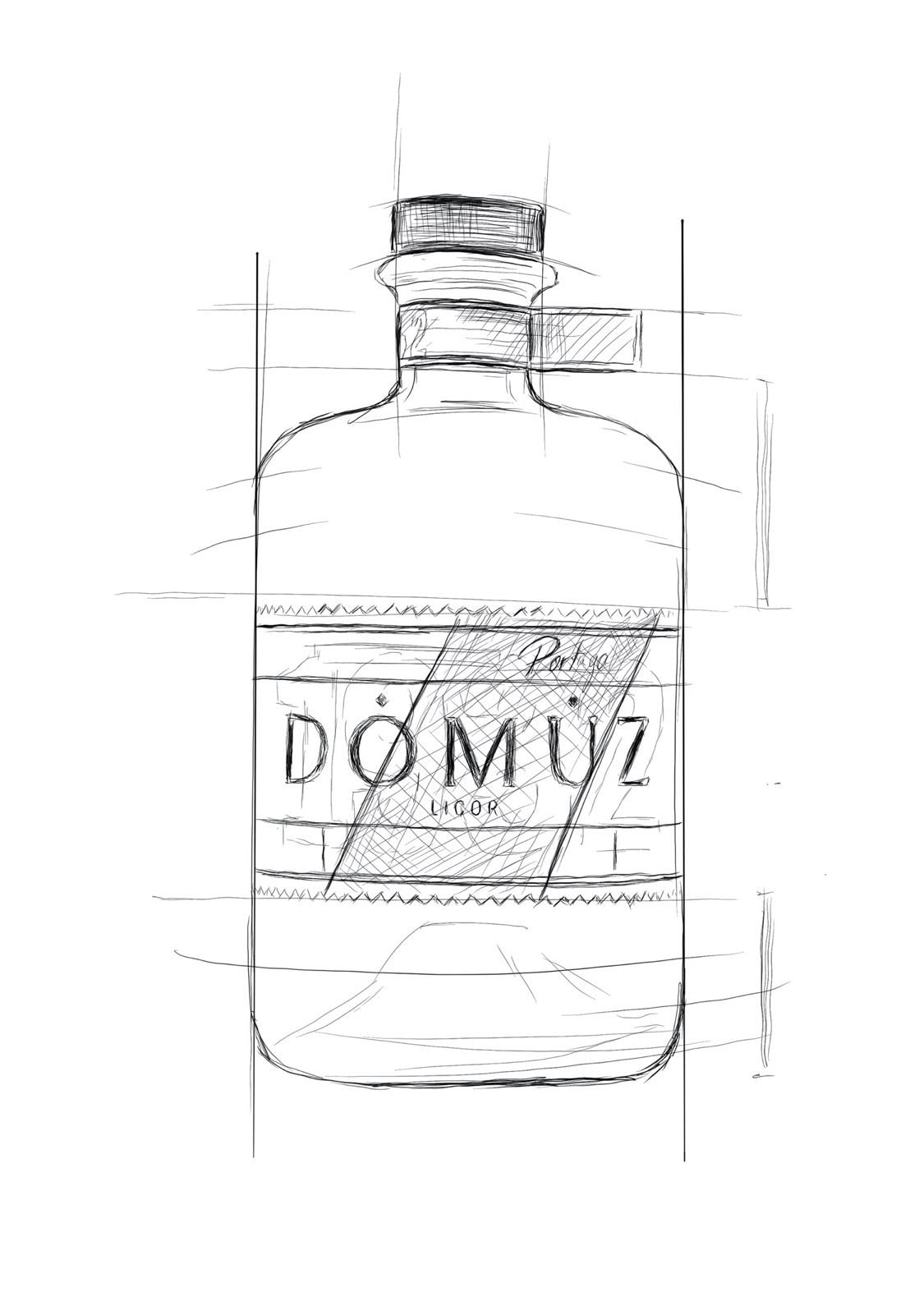
The brand’s rebranding is a tribute to this connection with the pharmacy, but “it is important that this is clear,” stresses André Coelho, “that Adega Mayor wants to move away from that universe, from that idea of medicines and chemistry, which today is not well regarded; people look for what is more natural and made in an artisanal way.” The inspiration was therefore “the pharmacy as alchemy, or even a more futuristic concept of mixology, the art of creating and mixing drinks and flavours.” It is, to a certain extent, a return to the roots, but adapted to the present world, in which cocktails are in fashion, as well as the bartenders who create them, late summer afternoon parties, the traditional amêndoa amarga drunk from a modern glass…
The key to the (good) result was that workshop. Several paths were proposed, post-its with ideas spread across the walls, and the rebranding concept was gradually narrowed down: “I even considered blue glass bottles, but the Adega Mayor team immediately showed me that was not the way to go. In one afternoon, we gained a week of work.”
Produced in a glass factory in Marinha Grande, using recycled glass, the new bottles for Dómúz liqueurs are therefore transparent, highlighting the colour of the liqueur itself. As for the shape, they are “inspired by the typical pharmacy bottle, which is completely disruptive compared to the original ones”. In addition, “they are closer to what is considered traditional today, even in the gin segment”. The labels are also completely different from those that previously identified the brand: “They are inspired by pharmacy labels. They have a white background and then an orange band for the coffee liqueur and a blue band for the bitter almond liqueur.”
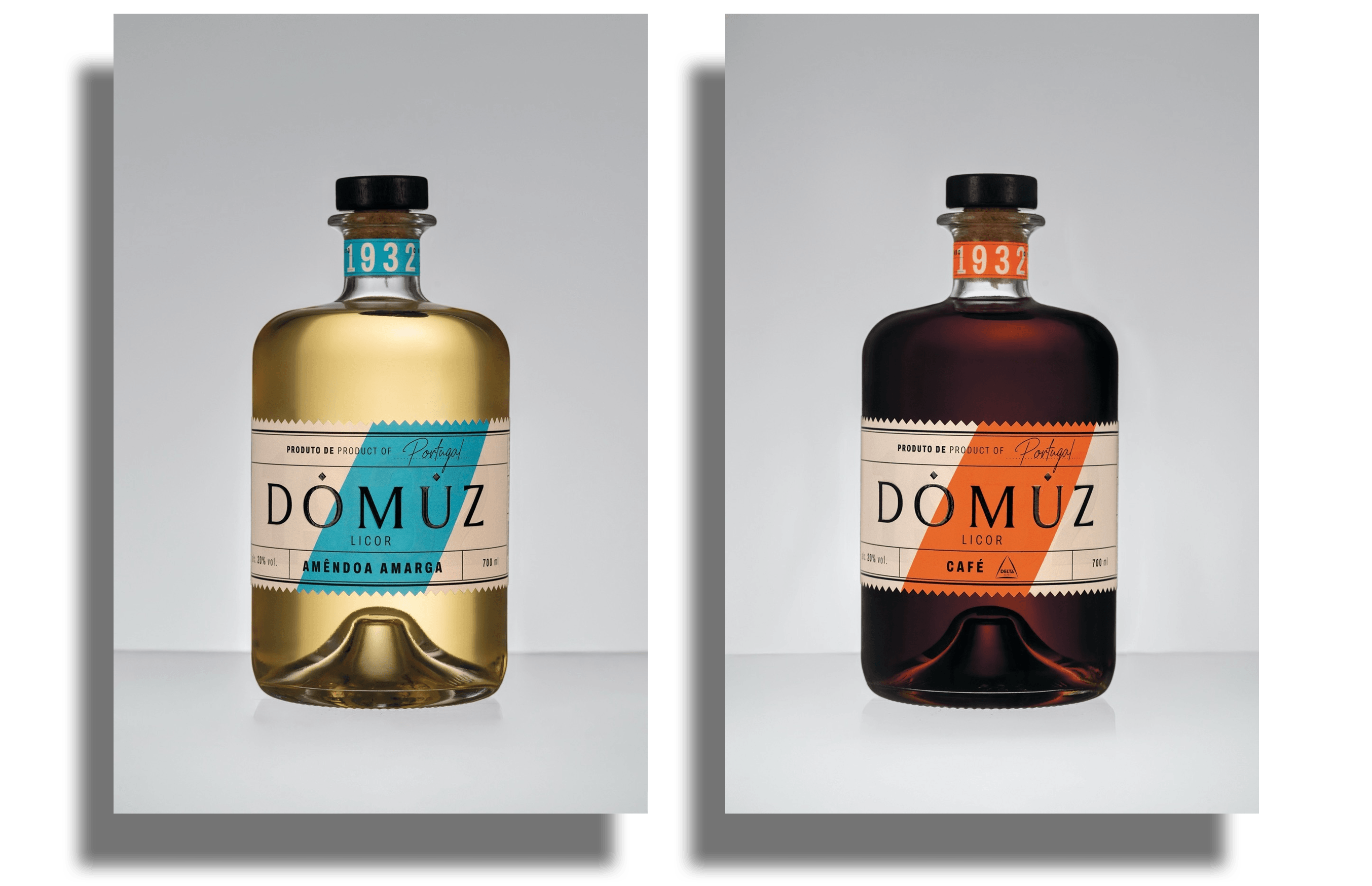
The Dómúz team did not bring preconceived ideas to the workshop, but it knew what mattered and needed emphasis: “Dómúz predates Delta and was a remarkable brand, with significant consumption, when Mr. Rui Nabeiro joined it through his commercial strength, which also carried great emotional value. In other words, it was a classic, and that could not be overlooked. On the other hand, with the passing of time, changing tastes, and the arrival in Portugal of a group of multinational brands that drove the evolution, diversification, and sophistication of this beverage category, the brand went into decline.”
With the reorganisation of the group and the governance model that placed Dómúz under the management team of Adega Mayor, it became clear that the brand still had enormous potential. This was the starting point for this rebranding, which is almost a refounding of Dómúz: “It was necessary to reinvent a classic, to modernise everything without giving up its history, and to respond to the trend of mixology, which still has significant room to grow.”